
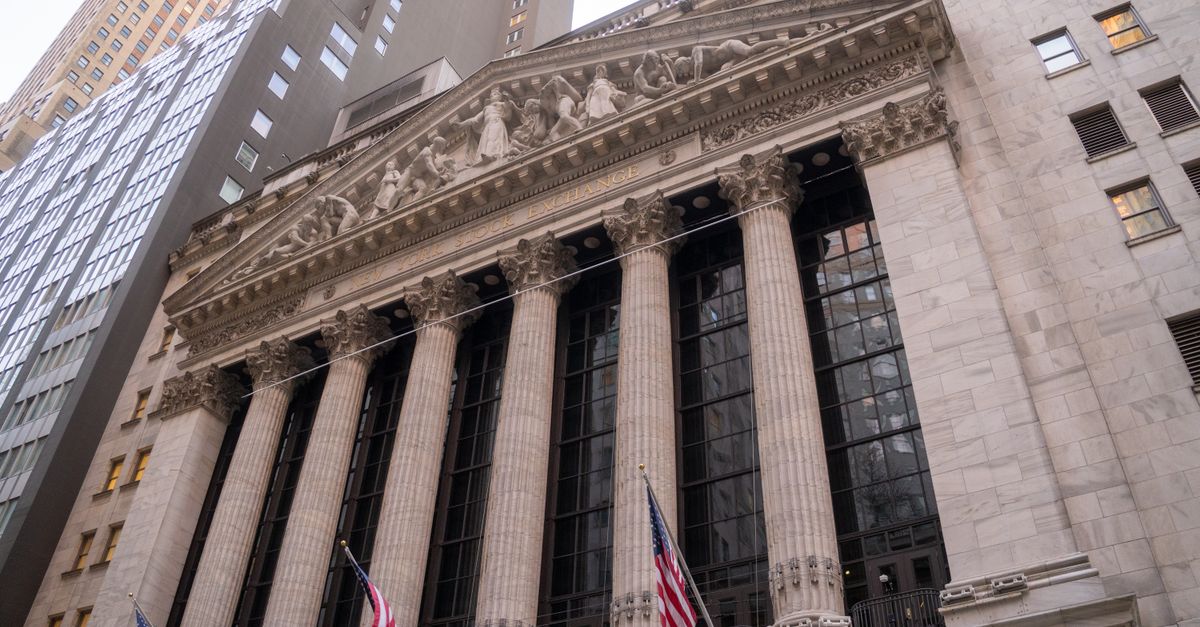
The New York Stock Exchange has signed a memorandum of understanding with crypto platform Blockchain.com to give the exchange’s users access to tokenized versions of US-listed stocks and ETFs. The agreement, announced the week of September 23, 2026, marks one of the clearest signs yet that a legacy exchange operator is willing to route tokenized securities distribution through a crypto-native venue rather than build that audience from scratch.
Under the deal, Blockchain.com users would eventually trade tokenized equities through NYSE’s planned digital alternative trading system, or ATS, once regulators sign off. The arrangement is not limited to trading access. It also includes a data-sharing component: ICE Data Services, an NYSE affiliate, would distribute Blockchain.com’s crypto market data to its own client base, while Blockchain.com would in turn integrate ICE and NYSE market data feeds into its platform. In effect, each side is agreeing to carry the other’s information alongside its own products.
Why the Timing Matters
The announcement lands just days after the US Securities and Exchange Commission introduced a five-year “Innovation Exemption,” a framework that lets certain tokenized securities venues use permissioned automated market maker liquidity pools without being reclassified as exchanges. The catch is a specific condition: tokenized stocks must carry rights equivalent to traditional shares. That requirement currently rules out some existing products on the market, including Kraken’s xStocks and Robinhood’s Stock Tokens, which do not meet that equivalence standard.
SEC Commissioner Hester Peirce has said the exemption addresses one particular model for tokenized securities and does not shut the door on other approaches. That distinction matters here: NYSE’s ATS plan and its tie-up with Blockchain.com represent a different structural bet than the token models Kraken, Binance, Coinbase and Robinhood have already rolled out. Rather than issuing a synthetic wrapper around a stock, NYSE appears to be positioning its regulated market infrastructure as the backbone, with Blockchain.com serving as a distribution channel to crypto-native users.
The regulatory backdrop is part of a broader pattern of institutions building out tokenized-asset rails this month. The European Central Bank, for instance, recently launched its own Pontes platform to settle tokenized assets in euros, and in that project the ECB has taken on the unusual dual role of both operator and buyer in a tokenized bond system. Traditional financial infrastructure providers on both sides of the Atlantic are converging on tokenization at roughly the same moment, even as they experiment with different governance models.
What the Numbers Show
The tokenized stock market is still small relative to traditional equities but growing quickly. According to data from RWA.xyz, the total value of tokenized stocks reached $3.14 billion as of Wednesday, up more than 18% over the prior 30 days. The number of holders grew even faster, climbing nearly 72% to reach 3.87 million over the same period. That gap between value growth and holder growth suggests the market is attracting a wider base of smaller participants rather than being driven purely by a handful of large positions.
For readers trying to gauge what this deal actually changes, the honest answer is: not yet very much, operationally. Nothing here is live. The MOU is a statement of intent, and the ATS itself is described as “planned,” contingent on regulatory approval that has not been granted. What the agreement does signal is intent and sequencing — NYSE wants a crypto-native distribution partner in place before its tokenized trading venue goes live, and it wants its market data flowing into crypto platforms regardless of how quickly the ATS itself gets approved.
What Comes Next
Several concrete markers will indicate whether this partnership moves from paper to product:
- Whether NYSE’s digital ATS receives regulatory approval, and whether it is structured to qualify for the SEC’s new Innovation Exemption or pursue a separate registration path.
- Whether the tokenized stocks and ETFs offered through this arrangement are built to carry rights equivalent to traditional shares, the condition the SEC has tied to exemption eligibility.
- How quickly the data-sharing piece — ICE Data Services distributing Blockchain.com’s crypto data, and Blockchain.com adding NYSE/ICE feeds — actually rolls out, since that portion does not appear to require the same regulatory sign-off as the trading venue.
- How competing tokenized equity products from Kraken, Binance, Coinbase and Robinhood adapt, given that some current offerings do not meet the equivalence standard the SEC has outlined.
The broader signal is one of convergence: exchanges built for crypto and exchanges built for traditional securities are increasingly reaching across the aisle rather than competing head-on, with data partnerships often preceding — and possibly outlasting — the trading products themselves.
Source: Cointelegraph
This content is for informational purposes only and does not constitute financial or investment advice.


Create a free account to comment and earn rewards.
Create account Log in