
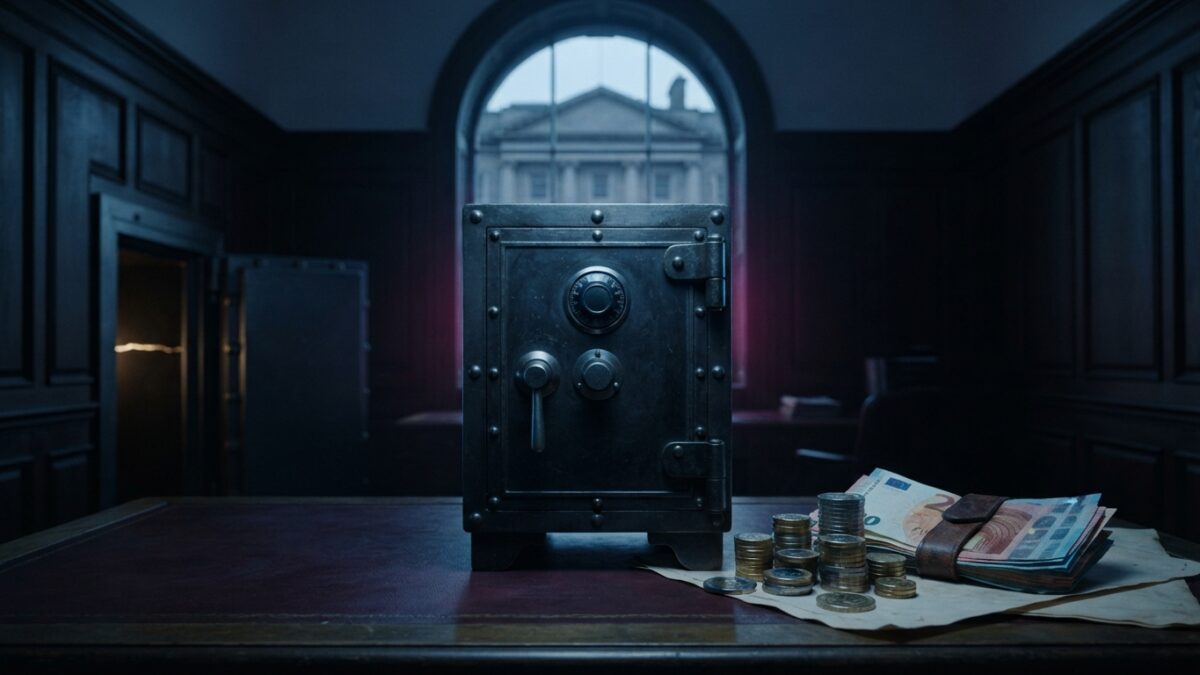
The Central Bank of Ireland has disclosed a settlement finding that Coinbase Ireland Limited left the account safeguarding its customers’ cash underfunded for more than a year, a gap that reached as high as €5 million on a single day in 2024. Coinbase Ireland has admitted the breaches, accepted a reprimand and a monetary penalty of €3,252,618, and the deal now awaits confirmation from the Irish High Court.
The case matters because Coinbase Ireland is not a side operation. It is the group’s e-money institution, the entity that issues and redeems the electronic money customers use to buy and sell crypto through other Coinbase entities. Under EU e-money rules, firms in this role must keep a safeguarding account funded at a level that matches their obligations to customers at all times, precisely so that a shortfall at the firm never becomes a loss for the people who deposited the money. That protection is what regulators found had been compromised, repeatedly, over an 18-month stretch.
How the shortfall built up
According to the regulator’s findings, the underfunding ran from January 1, 2023, to June 27, 2024. The maximum daily shortfall was €3 million in 2023 and grew to €5 million in 2024, though the average daily gap across the whole measured period was comparatively small, at 0.54% of Coinbase Ireland’s safeguarding obligations. The root causes were technical rather than a single dramatic failure: a change in reporting data in July 2022 led to incomplete safeguarding calculations, and a separate defect running from September 2023 to June 2024 caused unallocated customer funds to be omitted from the firm’s reconciliation process entirely.
Layered on top of those defects were structural weaknesses. Investigators found inadequate segregation of funds across different Coinbase entities and what the settlement describes as over-reliance on the US parent, Coinbase Inc., without sufficient independent oversight from the Irish entity. That dependency showed up concretely in March 2023, when 30 institutional customers were directed to deposit dollars directly into Coinbase Inc. accounts rather than through the Irish safeguarding structure — a routing decision that regulators flagged as part of the broader outsourcing problem, which was not fully resolved until December 16, 2024. A separate, later audit in August 2025 also found 33 users who still had access to UK accounts and were able to make deposits there, well after the period the fix was supposed to cover.
What it means for customers and the industry
Coinbase Ireland says the issues have been fully addressed and that no customer suffered financial loss as a result of the shortfall. That claim is plausible on its own terms — a reconciliation failure that leaves a safeguarding account temporarily underfunded is not the same as money actually disappearing, and nothing in the settlement suggests customer funds were spent, lost, or misappropriated. But the case is still a useful reminder of why safeguarding rules exist in the first place: they are supposed to work even when a firm’s internal systems break down, not only when everything goes according to plan. A 0.54% average shortfall sounds modest until it is restated as the firm not knowing, for over a year, exactly how much it owed its own customers at any given moment.
The timeline also shows how slowly these fixes can move once a defect is discovered. Coinbase Ireland’s risk mitigation program was only issued in January 2025, months after the underfunding period ended, and it was not closed out until June 2026. For a firm handling retail and institutional customer cash inside the EU’s regulatory perimeter, that is a long tail between identifying a control weakness and formally closing it, even accounting for the complexity of fixing reporting infrastructure shared across multiple corporate entities. The episode sits alongside a string of other recent regulatory actions touching Coinbase’s European operations, including a related finding over customer fund safeguards in Ireland and separate pushback from the company over proposed stablecoin rules in Brazil, suggesting that safeguarding and compliance architecture remains a live issue for the firm across jurisdictions.
What to watch next
The immediate procedural step is confirmation by the Irish High Court, which under the settlement framework will only withhold approval if the penalty is found manifestly disproportionate — a high bar that makes confirmation the likely, though not yet finalized, outcome. Beyond that, the case is worth watching as a marker for how EU regulators treat safeguarding and reconciliation failures at crypto-adjacent e-money institutions more broadly, at a time when regulators elsewhere are also scrutinizing how digital-asset firms structure deposit protections, as seen in ongoing debates over bank safeguards tied to stablecoin rules in the United States. Readers with accounts at Coinbase’s Irish entity may also want to watch for any further disclosures tied to the August 2025 audit findings on UK account access, since that issue appears to have surfaced after the main underfunding period had already closed, raising questions about how thoroughly earlier fixes were tested before being declared complete.
Source: CryptoSlate
This content is for informational purposes only and does not constitute financial or investment advice.



Create a free account to comment and earn rewards.
Create account Log in