
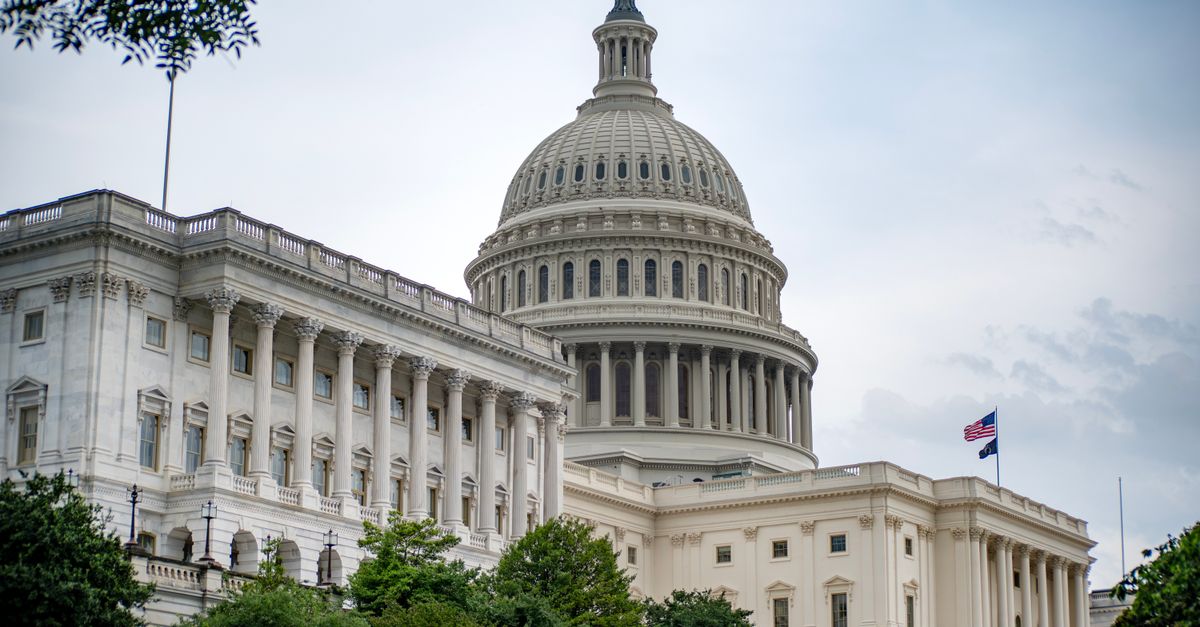
The US Senate on Tuesday failed to muster the 60 votes needed to advance the CLARITY Act, the bill meant to settle which federal regulator — the CFTC or the SEC — oversees digital assets, and the market reaction was immediate. Shares of Circle and Coinbase each fell roughly 10%, Bitcoin mining and treasury companies dropped between 4% and 8%, and Bitcoin itself briefly slipped below $75,000 before recovering to around $76,000.
A vote that stalls, not kills, the bill
The cloture motion needed 60 votes to move the CLARITY Act forward for debate and a final vote. It did not get them. That procedural failure does not formally end the bill, but it does something arguably more damaging in Washington terms: it burns time. Fewer than 36 legislative days remain before the current Congress gives way to a new one following the midterms, and any bill not passed by then must effectively restart from scratch in the next session.
The CLARITY Act has been the industry’s best hope for a durable answer to a question that has hung over US crypto markets for years — which agency has jurisdiction over which tokens, exchanges and platforms. Without that clarity, companies have operated under a patchwork of enforcement actions, court rulings and informal guidance rather than a clear statute. As Tuesday’s vote had been billed as a real test of whether the votes were there, the outcome confirms that the gap between the two parties has not closed as quickly as bill supporters had hoped.
Part of the breakdown traces to last-minute maneuvering. Senate Republicans had rewritten portions of the bill shortly before the vote in an attempt to shore up support, a move that triggered pushback from within their own ranks just hours before the cloture vote. Democrats, for their part, responded to what Republicans had characterized as a final offer with a counterproposal of their own, a sign that the two sides remain far apart on core terms rather than haggling over minor language.
What the selloff signals
The scale of the stock declines is instructive. Circle and Coinbase — companies whose business models depend heavily on the US regulatory environment being predictable — took the sharpest hits, each losing close to 10% of their value in a single session. Bitcoin miners and treasury-focused companies, including American Bitcoin, Strategy, Strive, Riot Platforms, CleanSpark, Hut 8 and IREN, also fell, though by smaller margins. That pattern suggests investors are treating regulatory uncertainty as a more immediate risk to companies whose revenue depends on US market structure — exchanges, stablecoin issuers, custody providers — than to Bitcoin holders or miners, whose exposure to US securities classification questions is comparatively narrower.
Bitcoin’s own dip below $75,000, followed by a partial recovery to roughly $76,000, reads less as a verdict on the asset itself and more as a liquidity-driven reaction across a market that had priced in at least some chance of legislative progress. The bounce suggests the initial reaction was sharper than the underlying reassessment of risk that followed.
The episode also underscores a split in how the industry’s own leaders have approached the stakes. Coinbase CEO Brian Armstrong had lobbied intensively for the CLARITY Act’s passage, and in August he predicted that the Senate would either pass the bill or that the CFTC and SEC would issue new rules by mid-September. Neither has happened. Michael Saylor of Strategy, by contrast, has downplayed the urgency of regulatory clarity altogether, arguing that Bitcoin’s own design makes such legislation less consequential for his company’s strategy. Tuesday’s stock moves suggest the market, at least for now, is siding closer to Armstrong’s view that regulatory certainty matters materially to valuations — Strategy’s shares fell too, if by less than Coinbase’s.
What to watch next
The immediate question is whether Senate leadership schedules another cloture attempt before the legislative calendar runs out, and whether Republicans and Democrats can narrow the gap exposed by the dueling proposals this week. Separately, a dispute over ethics questions tied to the Trump administration has also been cited as a complicating factor in the negotiations, adding a political dimension beyond the substance of market-structure rules.
- Whether Senate leaders bring a revised CLARITY Act back to the floor before the legislative calendar runs out
- Whether the CFTC or SEC moves independently on rulemaking in the absence of legislation, as Armstrong had floated as an alternative path
- How Circle, Coinbase and mining/treasury companies address investor concerns in upcoming earnings or public statements
- Whether bipartisan negotiators narrow the gap that produced dueling counterproposals this week
For now, the vote leaves US crypto companies where they have largely operated for years: without a settled statutory answer on jurisdiction, and dependent on the next legislative window, however narrow, to change that.
Source: Cointelegraph
This content is for informational purposes only and does not constitute financial or investment advice.



Create a free account to comment and earn rewards.
Create account Log in