
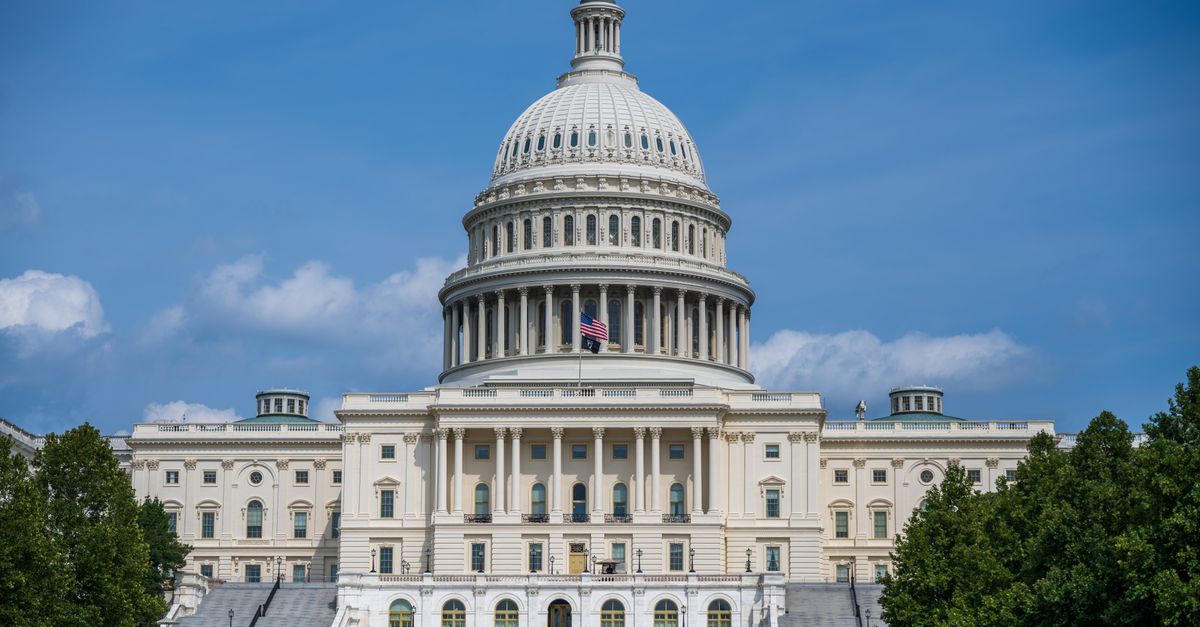
Senate Republicans released a final draft of the Clarity Act late Sunday, setting up a procedural vote Tuesday that will determine whether the most consequential piece of crypto legislation in years moves forward — or stalls out yet again. The bill needs 60 votes to advance, and with Democratic objections unresolved and banking groups still pushing back, the outcome is far from certain.
The Clarity Act would establish the first comprehensive federal framework for regulating digital asset markets in the United States, splitting oversight between the Commodity Futures Trading Commission and the Securities and Exchange Commission. The House passed its own version of the bill more than a year ago, but the Senate has spent months stuck on three thorny issues: how stablecoin issuers can offer rewards to holders, what legal protections should shield software developers who build non-custodial crypto tools, and how to handle the conflicts of interest created by President Donald Trump’s own crypto holdings.
What changed in the new draft
The revised text gives the Treasury Department an 18-month circuit breaker authority over stablecoin reward programs — a compromise meant to address concerns that yield-bearing stablecoins could function like unregulated bank deposits. That provision has not satisfied banking trade groups. The American Bankers Association and the Bank Policy Institute have said the circuit breaker doesn’t go far enough and are instead pushing for an outright ban on deposit-like rewards attached to stablecoins, arguing that anything short of a ban invites regulatory arbitrage against traditional deposit accounts.
On the ethics front, the new draft adds a role for state attorneys general in enforcing conflict-of-interest provisions tied to Trump’s crypto wealth, which includes his stake in World Liberty Financial and a memecoin bearing his name. That’s a shift from July, when Trump agreed to an ethics provision enforced solely by the Department of Justice — an arrangement Democrats, including Sen. Elizabeth Warren, criticized as toothless given the DOJ answers to the president. Whether adding state attorneys general resolves that concern is itself now a point of contention, as detailed in reporting on state AGs urging the Senate to reject the bill before Tuesday’s vote.
The draft also revises language in what’s known as the Blockchain Regulatory Certainty Act, a section meant to shield developers of non-custodial software — wallets, protocols, and similar tools — from being treated as money transmitters or otherwise held liable for how others use their code. The new version removes references to a federal criminal statute that would have explicitly protected those developers, a change that has drawn sharp criticism from the digital rights group Coin Center and from Rep. Tom Emmer, who has been a vocal advocate for developer protections in the House.
Why this matters beyond the vote count
The Clarity Act is not just another regulatory tweak — it would determine which federal agency has jurisdiction over which crypto assets, a question that has left exchanges, token issuers, and investors operating in a gray zone for years. A clear jurisdictional split between the CFTC and SEC would give the industry something it has lacked since the collapse of FTX: a rulebook. For stablecoin issuers specifically, the outcome shapes whether reward programs remain viable business models or get phased out under Treasury oversight.
The developer-protection fight matters too, because it touches on a broader question of whether people who write open-source financial software can be held legally responsible for how third parties use it. Weakening that safe harbor, as critics argue the new draft does, could chill development of non-custodial tools inside the U.S. even as other jurisdictions compete for that talent and capital — a dynamic playing out globally as other markets experiment with blockchain-based finance, including India’s pilot program tokenizing its corporate bond market.
And the ethics provisions are a test case for how Congress handles a sitting president’s personal financial stake in an industry it is actively regulating. Treasury Secretary Scott Bessent and the White House have pushed for passage, with administration officials expressing confidence the bill can clear procedural hurdles, but the unresolved conflict-of-interest questions remain, as covered in reporting on how a family loophole tied to Trump’s crypto interests has complicated negotiations.
What to watch next
- Whether Sen. Cynthia Lummis and other Republican sponsors can lock down the 60 votes needed, with Sens. Susan Collins and John Cornyn reportedly still undecided.
- How Sen. Mark Warner and other Democrats respond to the added state attorney general enforcement role — whether it’s enough to shift votes.
- Whether banking trade groups escalate lobbying against the stablecoin circuit-breaker language before or after Tuesday’s vote.
- Reaction from Coin Center and Rep. Emmer on the narrowed developer-protection language, and whether House negotiators push back if the bill advances.
- Analyst odds, including TD Cowen’s estimate of roughly a 25% probability the Clarity Act becomes law this year — a figure that reflects how unsettled the path to passage remains even after Tuesday’s vote.
For now, the bill’s fate rests on a narrow set of undecided senators and whether last-minute concessions on ethics enforcement and stablecoin rules are enough to bridge a divide that has persisted since the House passed its version over a year ago. More detail on the specific rewrites is available in coverage of the Senate Republicans’ rewritten draft ahead of the cloture vote.
Source: The Block
This content is for informational purposes only and does not constitute financial or investment advice.


Create a free account to comment and earn rewards.
Create account Log in